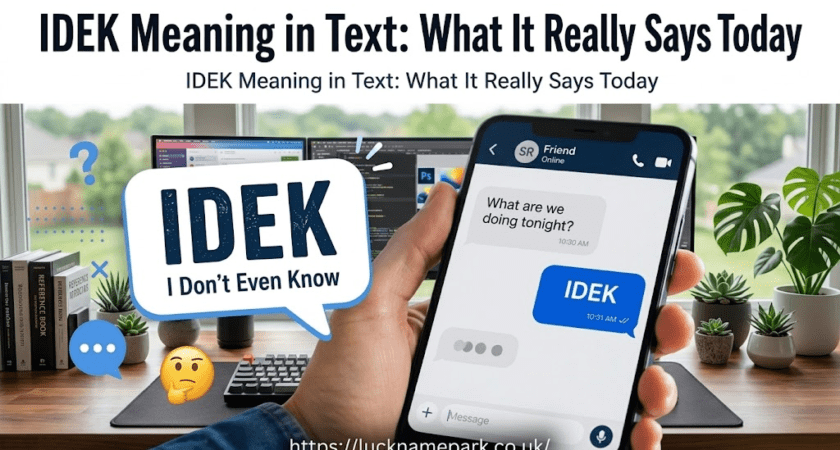
If you spend time texting friends, scrolling through social media, or chatting online, you have probably seen the term IDEK. Many people use it in conversations, comments, and messages because it is quick and easy to type. However, if you are new to internet slang, you may wonder about the IDEK meaning in text and how it should be used.
Text abbreviations have become a major part of online communication. They help people save time and express thoughts faster. IDEK is one of those common acronyms that appears on platforms like Instagram, TikTok, Snapchat, Facebook, and X. Understanding its meaning can help you follow conversations more easily and communicate like a native internet user.
In this guide, we will explain the IDEK meaning in text, provide real-life examples, discuss where it is commonly used, and compare it with similar slang terms. By the end, you will know exactly when and how to use IDEK confidently.
Table of Contents
Quick Overview Table: IDEK Meaning in Text
| Term | Full Form | Meaning | Usage |
| IDEK | I Don’t Even Know | Expresses confusion, uncertainty, or disbelief | Text messages, social media, chats |
| Type | Internet Acronym | Informal slang | Casual conversations |
| Popular Platforms | Instagram, TikTok, Snapchat, WhatsApp | Everyday communication | Online messaging |
| Tone | Casual | Friendly and conversational | Not for formal writing |
| Similar Terms | IDK, TBH, IMO | Common texting abbreviations | Digital communication |
What Does IDEK Mean in Text?
The IDEK meaning in text is “I Don’t Even Know.” People use this acronym when they are confused, unsure, surprised, frustrated, or unable to explain something.
The word “even” adds extra emphasis compared to simply saying “I don’t know.” It suggests stronger uncertainty or disbelief. When someone uses IDEK, they often mean that they are completely puzzled by a situation.
For example:
- “Why is the internet so slow today?”
- “IDEK, it’s been like this all morning.”
In this case, the person is saying they have absolutely no idea why the problem exists. The phrase sounds natural, casual, and relatable, which is why it has become popular among younger internet users.
The Origin of IDEK
Like many texting abbreviations, IDEK developed as online communication became faster. Early chat rooms, instant messaging platforms, and text messaging encouraged users to shorten phrases to save time.
The acronym combines:
- I = I
- D = Don’t
- E = Even
- K = Know
Over time, internet users adopted IDEK as a convenient way to express confusion or uncertainty. Today, it appears across many social media platforms and messaging apps.
Its popularity continues to grow because it captures emotions that simple phrases sometimes cannot express. People often use IDEK when they feel overwhelmed, shocked, or unable to explain a situation.
Why People Use IDEK in Conversations
The IDEK meaning in text goes beyond simply not knowing something. It also helps express feelings and reactions in a concise way.
People use IDEK because:
- It saves typing time.
- It sounds casual and modern.
- It communicates confusion clearly.
- It adds emotional emphasis.
- It fits naturally into online conversations.
For example:
“How did we end up talking for three hours?”
“IDEK, time went by so fast.”
Here, the speaker is not just saying they don’t know. They are expressing surprise as well.
This emotional layer makes IDEK more engaging than traditional responses.
Common Examples of IDEK in Text Messages
Understanding examples is the easiest way to learn the IDEK meaning in text.
Example 1
Friend: “What should we watch tonight?”
You: “IDEK. There are too many choices.”
Example 2
Friend: “Why is everyone talking about that video?”
You: “IDEK, but it seems popular.”
Example 3
Friend: “How did you lose your keys again?”
You: “IDEK. They were in my pocket earlier.”
Example 4
Friend: “What happened during the meeting?”
You: “IDEK. It was confusing.”
These examples show how IDEK naturally fits into everyday conversations
IDEK vs IDK: What’s the Difference?
Many people confuse IDEK with IDK. While they are similar, there is an important difference.
| Acronym | Meaning | Emotion Level |
| IDK | I Don’t Know | Basic uncertainty |
| IDEK | I Don’t Even Know | Strong confusion or disbelief |
Example Using IDK
“IDK what time the movie starts.”
This simply means the person lacks information.
Example Using IDEK
“IDEK how I forgot my own birthday plans.”
This suggests stronger confusion and surprise.
The word “even” adds emotional weight, making IDEK more expressive.
How IDEK Is Used on Social Media
The IDEK meaning in text appears frequently on social media because users often react quickly to posts, videos, and trends.
Common examples include:
- “IDEK why this video is so funny.”
- “IDEK what I just watched.”
- “IDEK how people do this challenge.”
- “IDEK where this trend started.”
Platforms where IDEK is popular:
- TikTok
- Snapchat
- X (Twitter)
- Discord
Its short format makes it perfect for comments and captions where space and speed matter.
When Should You Use IDEK?
IDEK works best in casual communication. It is ideal for conversations with friends, family, classmates, and online communities.
Use IDEK when:
- You are confused.
- You feel surprised.
- You cannot explain something.
- You want a relaxed tone.
- You are texting informally.
Examples:
- “IDEK what happened.”
- “IDEK why I’m laughing so much.”
- “IDEK how that worked.”
The phrase feels natural and friendly in these situations.
When You Should Avoid Using IDEK
Although the IDEK meaning in text is widely understood online, it is not suitable everywhere.
Avoid using IDEK in:
- Business emails
- Job applications
- Academic papers
- Professional reports
- Formal presentations
Instead, use complete phrases such as:
- “I do not know.”
- “I am uncertain.”
- “I am unable to determine.”
Professional communication requires clarity and formality, making internet slang less appropriate.
Similar Texting Acronyms Related to IDEK
Many internet users employ multiple abbreviations in the same conversation.
| Acronym | Meaning |
| IDK | I Don’t Know |
| TBH | To Be Honest |
| IMO | In My Opinion |
| BRB | Be Right Back |
| SMH | Shaking My Head |
| LOL | Laughing Out Loud |
| NGL | Not Gonna Lie |
| ICYMI | In Case You Missed It |
Learning these acronyms can improve your understanding of modern online communication.
Real-Life Situations Where IDEK Makes Sense
In my experience observing online communities and social media discussions, IDEK often appears when people react emotionally rather than logically. It is especially common when users encounter something unexpected.
For example, after watching a surprising movie ending, someone might post:
“IDEK what I just watched.”
After receiving unexpected news:
“IDEK how to react right now.”
These examples show that IDEK often communicates feelings as much as information. That emotional element is one reason the phrase remains popular across different age groups and social platforms.
Why Understanding Internet Slang Matters
Internet slang evolves quickly. New acronyms appear every year, while older ones become less common. Understanding terms like IDEK helps people participate more confidently in online conversations.
Benefits include:
- Better communication skills.
- Easier understanding of social media posts.
- Improved texting confidence.
- Faster online interactions.
- Greater digital literacy.
Learning the IDEK meaning in text is a simple step toward understanding modern internet culture and online language trends.
Frequently Asked Questions (FAQs)
1. What is the full form of IDEK?
IDEK stands for “I Don’t Even Know.”
2. What does IDEK mean in texting?
It means the sender is very confused, uncertain, or unable to explain something.
3. Is IDEK the same as IDK?
No. IDK means “I Don’t Know,” while IDEK means “I Don’t Even Know,” which adds stronger emphasis.
4. Is IDEK considered slang?
Yes. IDEK is internet slang and a common texting abbreviation.
5. Can I use IDEK in professional emails?
No. IDEK is best for informal communication and should generally be avoided in professional settings.
6. Is IDEK popular on social media?
Yes. IDEK is commonly used on Instagram, TikTok, Snapchat, WhatsApp, Facebook, and other social platforms.
Conclusion
Understanding the IDEK meaning in text is important for anyone who communicates online. The acronym stands for “I Don’t Even Know” and is used to express confusion, uncertainty, surprise, or disbelief. Compared to IDK, it carries stronger emotional emphasis and often reflects a deeper level of uncertainty.
As texting culture and social media continue to shape communication, acronyms like IDEK remain useful tools for quick and expressive conversations. Whether you see it in a text message, a TikTok comment, or a Snapchat chat, you now know exactly what it means and when to use it.
Have you seen other internet slang terms that confuse you? Learning them can make online conversations easier, more enjoyable, and much more engaging.