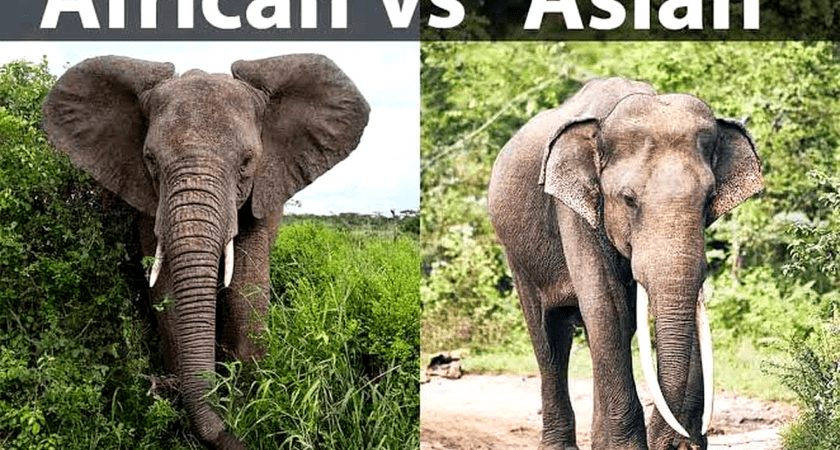
Elephants are the largest land animals on Earth. They are smart, emotional, and vital to their ecosystems . But did you know not all elephants are the same? Most people think of a big, gray animal with a trunk, but there are actually three distinct species. The main divide is between the African vs Asian elephant.
Understanding this difference is fascinating. Imagine seeing an elephant in the wild. Would you know which kind you were looking at? The differences go beyond just where they live. There are physical traits that make them unique, from the shape of their head to the size of their ears.
As someone who has studied wildlife for years, I can tell you that this is one of the most common questions people ask. It is important for conservation, too. By learning about these giants, we can better protect them. So, let us look at the main differences between the African and Asian elephant. This guide will make you an expert in no time.
Table of Contents
The Basics: Three Species, Not Two
Before diving into the “African vs Asian elephant” debate, we must understand the species. The African elephant is not just one type. Scientists have split it into two distinct species: the African savanna elephant and the African forest elephant . The Asian elephant is a separate genus. So, the comparison is usually between the African elephant (covering both savanna and forest) and the Asian elephant .
This distinction matters for conservation. The African forest elephant is now listed as Critically Endangered. The savanna elephant is Endangered. Asian elephants are also Endangered . Each faces different threats. Poaching for ivory impacts African elephants heavily. Meanwhile, Asian elephants suffer more from habitat loss and conflict with humans .
This classification helps conservationists target their efforts. When we talk about the African vs Asian elephant, we are comparing two very different animals genetically. They separated millions of years ago.
Size and Weight: Who is Bigger?
When comparing the African vs Asian elephant, size is the most obvious difference. African elephants are generally larger. The African savanna elephant is the biggest land animal on Earth. An adult male can stand up to 4 meters (13 feet) tall at the shoulder . They can weigh between 4,000 and 7,000 kilograms .
Asian elephants are smaller. They stand around 2 to 3.5 meters tall . Their weight ranges from 3,000 to 5,000 kilograms . This makes them shorter and stockier. This size difference is a key factor in identification.
However, there is a twist. The African forest elephant is smaller than the savanna elephant. They can be closer in size to the Asian elephant. But generally, if you see a massive elephant, it is likely an African one. This size gives the African elephant a different ecological role. They knock down trees and create clearings in the savanna .
Ear Shape: The Africa vs India Map
The ears are the most famous difference in the African vs Asian elephant comparison. African elephants have large ears. They are shaped roughly like the continent of Africa . Asian elephants have smaller ears. They are more rounded and shaped like the Indian subcontinent .
The reason for this difference is survival. African elephants live in hotter climates. Their big ears help them cool down. The ears are full of blood vessels. When an elephant flaps its ears, the blood cools down. This helps reduce the animal’s body temperature .
Asian elephants live in forested areas. They do not need such huge ears to cool off. They have smaller, more compact ears. So, if you see an elephant flapping giant, fan-like ears, it is likely an African one. If the ears are small and rounded, it is an Asian elephant.
Trunk: Fingers and Grip
The trunk is a vital tool for any elephant. But the African vs Asian elephant have different trunk tips. The African elephant has two “fingers” at the end of its trunk . These are fleshy projections. They allow the elephant to grasp small objects with precision. They can pick up a single blade of grass.
The Asian elephant has only one “finger” . To grip things, they wrap their trunk around the object. Imagine using one finger versus two. That is the difference in their dexterity.
This affects how they feed. African elephants use their two fingers to pinch and pick. Asian elephants use a wrapping motion. They both have powerful trunks. But the African elephant is generally more agile with its trunk tip.
Tusks: Who Has Them?
Tusks are another major distinction in the African vs Asian elephant comparison. In African elephants, both males and females have tusks . The tusks are long and curve outward. They are used for digging, fighting, and stripping bark .
In Asian elephants, it is different. Only some males have prominent tusks . Females do not have them. They may have “tushes.” These are small, stumpy tusks that do not protrude much . Many male Asian elephants are also tuskless. This varies by region. In Sri Lanka, fewer than 10% of males have tusks .
This difference has implications for poaching. Poachers target elephants with tusks. African elephants are more vulnerable because females also carry ivory. Asian elephants are targeted less for this reason, but they still face threats.
Head and Back Shape
The shape of the head and back is a reliable indicator. African elephants have a sloping back. It is concave in the middle. Asian elephants have a convex or humped back . This makes the Asian elephant look domed.
The head is different, too. African elephants have a rounded forehead. Asian elephants have a twin-domed head. There is an indent in the middle of the forehead . This is sometimes called a “double bump.”
These features are subtle. But when you know what to look for, they are easy to spot. They help in the African vs Asian elephant identification guide.
Skin Texture
Skin texture is another clue. African elephants have very wrinkled skin. It is more deeply folded. This helps trap moisture. It keeps them cool in the heat .
Asian elephants have smoother skin. It is still wrinkly, but less so. They also have patches of depigmentation. These are pink patches on the ears, trunk, and forehead. These become more visible as they age .
Toenails
Even toenails can help tell the difference. African elephants have a different number of toenails. They have 4 or 5 nails on the front foot and 3 on the back .
Asian elephants have 5 on the front foot and 4 or 5 on the back . This is a minor detail. But it is useful if you are looking at footprints.
Brain Size: A Surprising Difference
Recent research has revealed something surprising. The African vs Asian elephant debate has a new angle: brain size . Scientists studied the brains of both species. They found that Asian elephants have larger brains than African elephants. This is despite their smaller body size .
Asian female elephants have heavier brains. They average 5,346 grams. African savanna females average 4,417 grams . This challenges older assumptions. It suggests that brain size is not just about body mass.
Asian elephants also have more cortical gray matter. This is the part of the brain responsible for higher thinking. African elephants have larger cerebella. This is the part of the brain for movement . These findings are fascinating. They highlight the complex evolution of these animals.
Habitat and Range
Where they live is a fundamental difference. The African vs Asian elephant are separated by geography. African elephants live in Africa. They are found in 37 countries south of the Sahara . They live in a variety of habitats. This includes savannas, forests, and even deserts.
Asian elephants live in Asia. They are found in 13 countries. This includes India, Sri Lanka, and Southeast Asia . They prefer forest habitats. They are found in tropical and subtropical forests. Their habitat is more fragmented. This is due to human population pressure.
This difference in range impacts their conservation. African elephants have vast ranges. But Asian elephants live in closer proximity to humans. This increases conflict .
Social Structure: Family Life
Both species are highly social. But there are differences. African elephants live in complex, large herds. These can have up to 100 individuals . They are led by a matriarch. The matriarch is the oldest, most experienced female .
Asian elephants have smaller groups. They often have 6 to 7 related females and their young . While they do have a matriarch, the structure is less rigid . Male elephants of both species leave the herd. They become solitary or form bachelor groups.
The social bonds in African elephant herds are very strong. They are vital for survival. They teach each other where to find water. The social structure is more defined in the African species.
Diet and Eating Habits
Elephants are herbivores. They eat a lot of plant matter. The African vs Asian elephant have similar diets. They both eat grasses, leaves, bark, and fruit . But there are slight differences.
African elephants are grazer-browsers. They eat more grass. They are found in open savannas. This allows for more grazing. Asian elephants are mainly browsers. They eat more leaves and twigs. They live in forests where this is more abundant .
Their eating habits affect their environment. They create clearings. They spread seeds. They are “ecosystem engineers.” This is true for both species.
Temperament and Trainability
There is a common belief that Asian elephants are easier to train. This is a part of their long history with humans. Asian elephants have been semi-domesticated for thousands of years . They have been used for work and in ceremonies. African elephants are considered more difficult to habituate . Historical attempts to use them for work met with limited success.
This behavioral difference is thought to be related to their social structure and environment. It is not a rule. But it is an observed pattern. This adds a behavioral layer to the African vs Asian elephant discussion.
Conservation Status: A Race Against Extinction
The conservation status of both species is alarming. This is the most important part of the African vs Asian elephant story. African savanna elephants are Endangered. African forest elephants are Critically Endangered. Asian elephants are also Endangered .
The threats are different. African elephants face a major threat from poaching. The illegal ivory trade is devastating . Asian elephants lose their habitat to human development. This leads to conflict. They raid crops. They are killed in retaliation .
Conservation efforts are underway. But it is a race against time. We must protect these incredible animals.
Quick Comparison Table: African vs Asian Elephant
| Feature | African Elephant | Asian Elephant |
| Scientific Name | Loxodonta africana (Savanna) / L. cyclotis (Forest) | Elephas maximus |
| Size | Larger (Up to 4m tall) | Smaller (Up to 3.5m tall) |
| Weight | 4,000 – 7,000 kg | 3,000 – 5,000 kg |
| Ears | Larger, Africa-shaped | Smaller, rounded |
| Back Shape | Concave (dips down) | Convex (domed) |
| Head Shape | Rounded, one dome | Twin domes, indent |
| Trunk Tip | Two “fingers” | One “finger” |
| Tusks | Both males and females have tusks | Only some males have tusks |
| Skin | More wrinkled | Smoother, with pink patches |
| Toenails | Front: 4/5, Back: 3/4 | Front: 5, Back: 4/5 |
| Habitat | Savanna, forests, deserts (Africa) | Forests, grasslands (Asia) |
| Brain | Smaller (in studies) | Larger (in studies) |
Frequently Asked Questions
1. Which is bigger: the African or Asian elephant?
The African elephant is bigger. Specifically, the African savanna elephant is the largest land animal. They can weigh over 6,000 kg. Asian elephants are smaller, weighing up to 5,000 kg .
2. Can you tell the difference by the ears?
Yes! This is the easiest way. African elephants have large ears shaped like Africa. Asian elephants have smaller, rounded ears .
3. Do all elephants have tusks?
No. In African elephants, both males and females have tusks. In Asian elephants, only some males have them. Females rarely have visible tusks .
4. What is the difference in their trunk?
The African elephant has two “fingers” at the trunk tip. This helps them pick up small items. The Asian elephant has one “finger.” They wrap their trunk around objects .
5. Are African elephants more aggressive than Asian elephants?
It is commonly thought that African elephants are more aggressive. Asian elephants have a longer history of semi-domestication. This suggests a difference in temperament .
6. Why is the African forest elephant different?
The African forest elephant is a separate species. It lives in Central African forests. It is smaller than the savanna elephant. It has straighter, downward-pointing tusks .
Conclusion
The African vs Asian elephant comparison reveals two distinct animals. They have evolved to survive in different environments. The African elephant is the largest land animal. It has huge ears and a sloping back. The Asian elephant is smaller, with rounded ears and a domed back.
Understanding these differences is important for their protection. These are intelligent and social creatures. They are vital to their ecosystems. We must ensure their survival.
Next time you see an elephant, you will be able to identify it. You will know whether it is an African or Asian elephant. You will understand their unique adaptations. Let us continue to learn about and protect these amazing giants.