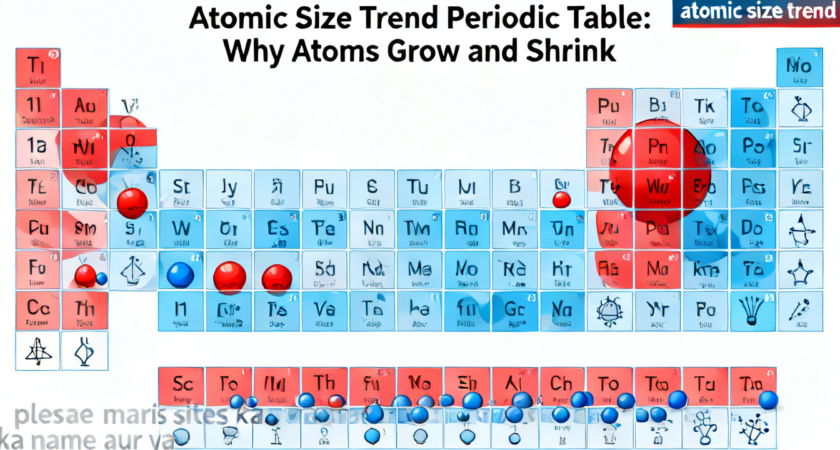
Have you ever wondered why some things in nature follow a perfect pattern? The atomic size trend periodic table is one of those cool patterns. Just like people come in different heights, atoms come in different sizes. But unlike humans, atoms change their size based on where they sit on a map called the periodic table. When we talk about the atomic size trend periodic table, we are looking at the “personal space” an atom takes up. This space is usually measured from the very center of the atom to its outermost edge. If you can imagine an atom as a tiny fuzzy ball, the atomic size is just how big that ball is. Learning this helps us understand how chemicals react and why some materials behave the way they do. It is like having a secret key to unlock the mysteries of how the world is built at a microscopic level.
What Exactly is the Atomic Size Trend?
The atomic size trend periodic table tells us a story about how atoms grow or shrink. Think of it like a giant grid where every element has its own house. As you walk through these houses, you notice the atoms aren’t all the same. Scientists call this “atomic radius.” It is the distance from the nucleus, which is the heart of the atom, to the outer shell where electrons hang out. Because electrons are always moving, it is hard to find a sharp edge. So, we measure the distance between two atoms that are touching and cut that number in half. This atomic size trend on periodic table is not random at all. It follows strict rules of physics. When you understand these rules, you can predict how an element will act even if you have never seen it before. It makes science feel a bit like magic because you can guess the “size” of an invisible particle just by knowing its name and spot on the chart.
When you move from left to right across a row, something strange happens. Even though the atoms are getting heavier, they are actually getting smaller. This is a huge part of the periodic table atomic size trend. As you move right, you add one proton to the center of the atom. Protons have a positive charge. This extra charge acts like a stronger magnet. It pulls the negative electrons closer to the middle. Imagine holding a bunch of balloons and pulling the strings tighter toward your hand. The balloons stay the same in number, but the whole bunch takes up less space. This “magnetic pull” is why the atomic size trend periodic table shows a decrease in size as you move toward the right side. Even though the atom has more “stuff” inside it, that stuff is packed much more tightly. This explains why an atom like Fluorine is much smaller than Lithium, even though they are in the same row.
Moving Down: Why Groups Make Atoms Bigger
Now, let’s look at what happens when you move down a column or “group.” In this part of the atomic size trend periodic table, the atoms get much bigger very quickly. Every time you move down one step, the atom adds a whole new layer of electrons. Think of it like putting on a thick winter coat over your clothes. Then, you put another coat over that one. Each layer makes you wider and takes up more room. These layers are called “energy levels.” Because these new layers are further away from the center, the middle “magnet” cannot pull them in as easily. This makes the periodic table atomic size trend increase as you go down. The bottom of the table is home to the giants of the atomic world. Francium, located at the very bottom left, is one of the biggest atoms because it has so many layers and a relatively weaker pull on its outer edges compared to its size.
The Role of the Nucleus in Atomic Size
The nucleus is the command center of the atom. It holds the protons that determine how the atomic size trend on periodic table works. As we mentioned, more protons mean a stronger pull. This is often called “Effective Nuclear Charge.” If the nucleus is strong, it keeps its electrons on a short leash. If the nucleus is shielded by many inner layers of electrons, it can’t hold onto the outer ones as tightly. This “shielding effect” is a big reason why the atomic size trend periodic table behaves the way it does. It is a constant tug-of-war between the center of the atom and the electrons orbiting it. When the center wins, the atom stays small and compact. When the outer layers are too far away or blocked, the atom stays large and fluffy. Understanding this balance is the key to mastering chemistry and moving beyond just memorizing names on a chart.
How Shells and Energy Levels Affect Growth
Each atom has specific paths where electrons live, known as shells. In the atomic size trend periodic table, these shells are like the floors of a building. Hydrogen only has one floor. But as you go down the table to elements like Cesium, you are adding many more floors. Each new floor adds significant height to the building. This is why the periodic table atomic size trend is so obvious when looking at columns. Even if the nucleus gets more protons, the sheer volume of these extra shells overrides the pull. It is impossible to keep a seven-story building as short as a one-story house, no matter how strong the foundation is. This physical growth is the most visible part of the atomic size trend on periodic table. It reminds us that matter takes up space and that the way electrons are organized is the primary reason for the volume of everything we touch and see in our daily lives.
Comparing Metals and Non-Metals
If you look at the left side of the table, you find the metals. These are usually the larger atoms in the atomic size trend periodic table. Metals like to lose electrons, and they don’t hold onto their outer layers very tightly. This makes them appear larger and more spread out. On the right side, you find the non-metals. These atoms are the “greedy” ones. They want to pull in more electrons and hold their own very close. This creates the periodic table atomic size trend where the right side of the table is much more compact. When a metal and a non-metal meet, the size difference helps them bond together. The big metal atom gives up an electron to the small, tight non-metal atom. This interaction is fueled by the atomic size trend on periodic table. It shows that size isn’t just a number; it dictates how elements shake hands and create new substances like salt or water.
Why Does This Trend Matter in Real Life?
You might think that the atomic size trend periodic table is just for textbooks, but it affects your life every day. For example, the size of an atom determines how well it can conduct electricity. Larger atoms often let their electrons flow more freely, which is why metals are great for wires. Small atoms hold their electrons tight, making them good insulators. The periodic table atomic size trend also explains why some medicines work. Doctors design molecules that fit into specific “locks” in your body. If the atoms are the wrong size, they won’t fit, and the medicine won’t work. By knowing the atomic size trend on periodic table, scientists can build better batteries, stronger metals for airplanes, and even more effective sunscreens. It is the blueprint for engineering the materials of the future. Every smartphone and computer exists because we understood how to manipulate these tiny building blocks based on their size and behavior.
Exceptions to the Rules: Transition Metals
In science, there are almost always exceptions. While the atomic size trend periodic table is very consistent for the main groups, the transition metals in the middle are a bit different. As you move across the middle of the table, the sizes don’t change quite as much. This is because the electrons are being added to an inner layer rather than the outermost shell. This provides a “shield” that cancels out the extra pull from the nucleus. So, the periodic table atomic size trend stays relatively flat in this area. It is like adding people to the middle of a crowd instead of making the circle wider. The overall size of the crowd stays about the same. Even with these small deviations, the atomic size trend on periodic table remains the most reliable way to visualize the atomic world. It teaches us that while general rules are great, paying attention to the small details helps us see the full picture of how chemistry functions.
Visualizing the Trend: A Simple Summary
To keep the atomic size trend periodic table simple, just remember two directions. If you go Down, you go Big. If you go Right, you go Small. This creates a diagonal arrow of size. The smallest atoms are in the top right corner (like Helium), and the largest are in the bottom left (like Francium). When you look at a chart, visualize the atoms as spheres that slowly inflate as you move your finger down a column. Then, watch them deflate as you slide your finger across a row to the right. This mental image makes the periodic table atomic size trend easy to remember for exams or lab work. It is the most fundamental “look” of the periodic table. Most other trends, like how much energy it takes to remove an electron, are actually based on this atomic size trend on periodic table. If you know the size, you know the strength of the atom.
Tips for Remembering the Atomic Size Trend
If you are struggling to memorize the atomic size trend periodic table, try using “The Snowman” trick. Imagine a snowman. He has a small head on top and a big snowy bottom. This represents going down a group—atoms get bigger! Now, imagine the snowman falls over to the right. As he rolls, he gets squished and smaller. This represents going across a period. Using silly images like this makes the periodic table atomic size trend stick in your brain much better than just reading a book. Another way is to think of the nucleus as a magnet and electrons as metal bits. More magnets (protons) in a small space pull the metal bits closer. This is why the atomic size trend on periodic table is so logical once you see the “why” behind it. Science isn’t about memorizing; it is about seeing the logic in how things are built.
Conclusion
The atomic size trend periodic table is a beautiful example of how organized our universe is. From the smallest hydrogen atom to the largest heavy metals, everything has a place and a reason for its size. We have learned that adding shells makes atoms bigger, while adding protons in a row pulls them tighter and makes them smaller. This periodic table atomic size trend is the foundation for understanding chemical bonds, electricity, and even the biology of our own bodies. By mastering the atomic size trend on periodic table, you aren’t just learning chemistry; you are learning the language of the physical world. Next time you look at a periodic table, don’t just see boxes and letters. See a map of sizes that tells the story of how every object around you is put together. Keep exploring and asking questions, because even the smallest atoms have big secrets to share!
FAQs
1. Which element has the largest atomic size? According to the atomic size trend periodic table, Francium (Fr) is generally considered to have the largest atomic size. It is located at the very bottom left of the table, meaning it has many electron shells and a relatively lower pull from the nucleus on its outer electrons.
2. Why do atoms get smaller as you move to the right? This happens because you are adding more protons to the nucleus. This increases the “positive charge,” which pulls the negative electrons in closer. This part of the periodic table atomic size trend shows that more “pulling power” results in a more compact and smaller atom.
3. Does the number of neutrons affect the atomic size? Not really. Neutrons have no charge, so they don’t pull on electrons. While they add mass (weight), they don’t change the atomic size trend on periodic table. Only protons and electrons really dictate how much space an atom occupies.
4. What is the smallest atom on the periodic table? Helium (He) is the smallest atom. It is in the top right corner. Because it has a full outer shell and its electrons are very close to the nucleus, it is very tight and compact, following the atomic size trend periodic table rules perfectly.
5. How is atomic size actually measured? Since atoms don’t have hard edges, scientists measure the distance between the nuclei of two identical atoms joined together. They then divide that distance by two. This gives us the “atomic radius,” which defines the periodic table atomic size trend.
6. Why is the atomic size trend important for chemistry? It helps scientists predict how atoms will react. For example, larger atoms usually lose electrons more easily, making them more reactive in certain situations. Understanding the atomic size trend on periodic table is essential for creating new chemical reactions and materials.
References:
- Chemistry: The Central Science (Brown, LeMay, Bursten)
- Royal Society of Chemistry – Periodic Table Trends
- National Center for Biotechnology Information (NCBI) – Atomic Properties